
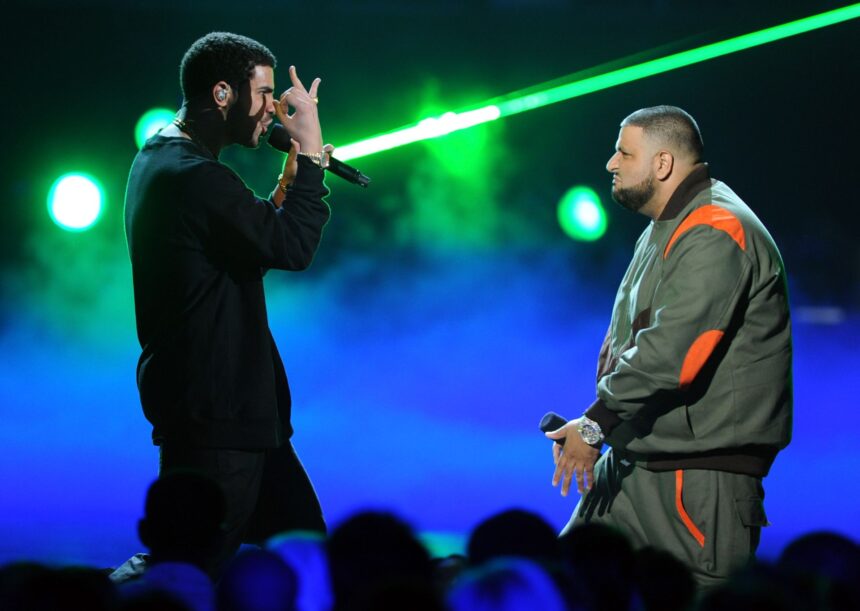
The Toronto rapper’s jab at his former collaborator exposed the strange role Gaza now occupies in public life — less a political reality centered on those impacted than a way for audiences to judge celebrity integrity
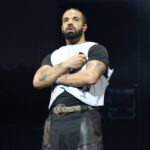
Late last week, Drake dropped a barrage of new releases with the kind of spectacle that we’ve come to expect from the rapper. In the run-up to the three-album and multiple music video drop, there were the usual livestreams and cryptic posts. But there was also a massive 25-foot ice sculpture erected in downtown Toronto (that fans attacked with flamethrowers and sledgehammers to uncover a hidden release date), a sprawling fireworks display over the city’s waterfront (which included illuminating the CN tower, once the world’s tallest freestanding structure, with lights that cost over $15 million), and even the participation of Toronto Mayor Olivia Chow, who publicly welcomed the Toronto native to City Hall for a video shoot. The White House joined in the spectacle, posting an edited version of one of the album covers.
Among the albums was one titled “Habibti,” an example of the rapper’s long flirtation with Arab aesthetics and the Arabic language. But it was a set of bars, buried in the track “Make Them Pay” on the “ICEMAN” album and aimed at a famous Arab American, that got everyone’s attention: “And, Khaled, you know what I mean / The beef was fully live, you went halal and got on your deen / And your people are still waitin’ for a free Palestine / But apparently everything isn’t black and white and red and green, damn / I’m seein’ everyone’s true colors, for real, I’m sensin’ a theme.”
The line was referring to DJ Khaled, who has remained conspicuously silent on Gaza for nearly three years despite being perhaps the most globally recognizable Palestinian-American celebrity alive. Drake’s lyric revived an old frustration (as Maysa Mustafa wrote in her 2024 Spotlight “DJ Khaled’s Disappearing Act”) that has followed Khaled since late 2023, when Palestinians and Arabs online began openly questioning how a man who had built an empire loudly performing Arab identity could become selectively mute as Gaza burned.
But the lyrics weren’t well received by everyone. “Another example of Palestine being used as a gotcha moment,” one user wrote on X. Others pointed out the obvious contradiction that Drake himself has never really attached meaningful political commitments to his carefully cultivated public persona. Another user posted that the move was “pretty hypocritical considering this is the first time he’s ever mentioned Palestine and it’s only to drag someone he dislikes.” Popular radio and TV host Charlamagne tha God, speaking on hip-hop and R&B morning radio show “The Breakfast Club,” asked: “What have you ever stood for, Drake? … I ain’t never heard you say ‘Black lives matter.’”
Though some users pointed out that Drake had quietly signed the Artists4Ceasefire letter in late 2023, the reality is that he’s otherwise remained largely detached from any substantive advocacy. That’s why, to many, his recent lines about Palestine don’t really feel like solidarity.
Still, the exchange revealed something more than just another rap feud. Palestine has increasingly become one of the central ways audiences evaluate the authenticity of public figures. In the post-Oct. 7 world, celebrities and politicians are judged on what they say about Gaza, if anything at all.
The same logic recently showed up in debates on the American left after Rep. Alexandria Ocasio-Cortez criticized those aligning with consummate conspiracy theorist and former Rep. Marjorie Taylor Greene over Gaza, arguing that Greene’s broader politics made her an unreliable ally. Critics responded by insisting that Greene had nevertheless taken political risks to oppose Israel’s war and pointed to Cortez’s closeness to Joe Biden, whose enduring support of Israel did not wane during its genocidal assault on Gaza.
Once again, the discussion drifted away from Palestinians themselves and veered toward adjudicating the hypocrisy and moral legitimacy of the people speaking about them. Perhaps the most frustrating part of it all is that this has the counterproductive effect of distracting everyone from the ongoing genocide, occupation and land dispossession that makes up the daily reality for Palestinians in Gaza and the West Bank.
For years, Khaled leveraged a caricature of Arabness with the “habibis” peppered throughout his speech and the maqluba dish he shared that went viral, but he was nevertheless embraced by many Arabs and Palestinians who saw in him a rare form of visibility in American entertainment. As Mustafa wrote, “Any ounce of representation was appreciated, especially from one of our own.” That is precisely why his silence on Gaza felt so jarring to many observers.
The frustration with Khaled was never really about expecting celebrities to solve political crises. Mustafa herself questioned that expectation at the time, asking, “Do Palestinians really need him?” And the answer, still, is probably not. The pro-Palestinian movement has hardly suffered from a lack of visibility lately. Massive protests erupted across the world, some of the biggest and most sustained of our time. Celebrities from Dua Lipa to Billie Eilish, Zayn Malik and The Weeknd publicly expressed solidarity. Palestinians themselves documented the destruction of Gaza in real time, bypassing the traditional gatekeepers of celebrity advocacy altogether (and even being recognized with multiple awards and other accolades in the process).
And yet somehow Khaled’s silence still mattered culturally, because it exposed the uneasy relationship between identity as mere aesthetic and identity as obligation. It’s easy to perform Arabness when it is meme-able, marketable and, ultimately, profitable. Not so much when that expression carries cultural and political risk, as we have seen with countless celebrities and public figures who have faced cancellation and other forms of retribution over their stances on Palestine.
But Drake is hardly outside this dynamic. For years, he has dabbled in different cultures (Jamaican dancehall most prominent among his samples), sometimes earning him the title of “culture vulture,” or even “colonizer” as his rival Kendrick Lamar famously called him on his record-breaking diss track “Not Like Us.”
It’s worth noting that DJ Khaled has been instrumental in Drake’s rise as a pop star, and was among the first successful producers to feature the rapper on a song back in 2009. The two shared one of the most commercially successful partnerships in pop music history, and their frequent collaborations defined an era of music. In 2021, DJ Khaled even sent the Canadian-Palestinian Al-Asala Dabke Group to perform a zaffa procession for Drake’s 35th birthday in Los Angeles.
Drake often references Arab culture, and Khaled is but one of the Arab collaborators he surrounds himself with. His longtime producer, Noah “40” Shebib, is Lebanese-Canadian. Oliver El-Khatib, who co-founded the OVO Sound record label alongside Drake and Shebib, is also of Lebanese descent. Their multimillion-dollar OVO clothing brand features a few capsule collections incorporating Arabic script, and for years the rapper could be spotted frequenting a shisha lounge in Toronto called Habibiz, undoubtedly helping to popularize the pastime (a staple in Arab cultures) in Western hip-hop.
In 2020, Drake famously rapped a bar in broken Arabic on a freestyle with British rapper Headie One. He frequently drops “wallahi” in his tracks, including in a 2015 remix of “Sweeterman,” where he can also be heard saying “mashallah.” Last year, he teased the release of ICEMAN by sampling Fairuz’s “Wahdon.”
The “Habibti” album (the cover of which features Egyptian-American rapper Stunna Sandy, who appears on a track in the companion album “Maid of Honor”) also continues this pattern of a proximity to Arabness that’s part of a broader branding strategy that allows him to move seamlessly through different cultures and aesthetics without having to commit to any. We see this in Khaled’s performance of Palestinianness, and his slipping out of it when the going gets tough.
The pro-Palestine movement may not need celebrities to speak for it, but Palestine continues to function as a social mirror through which audiences seem to assess everyone else’s integrity. What this new Drake-Khaled feud ultimately reveals is not just celebrity hypocrisy, but the strange role Palestine now occupies in public life. Palestine has become a litmus test, but one that risks turning urgency into an endless cycle of evaluation instead of meaningful action.