


Eurovision’s televote has come under increased scrutiny by broadcasters, the media, and viewers following 2025’s Song Contest. Sharleen Wright discusses some of the changes and their impact on 2026’s voting experience.
Reducing The Number Of Televotes
Following ESC Insights’ investigation into the 2025 public vote, we have a keen interest in how the voting system works and what the EBU would put in place ahead of the Eurovision Song Contest 2026.
When the EBU held a vote at its assembly in December 2025, the key argument made to its members to accept the changes, brought in due to pressure from broadcasters with concerns of skewed voting numbers, was that by reducing the number of votes from 20 to 10, it would limit the ability to vote en masse and thus provide the legitimacy they were seeking.
“While we are confident the 2025 Contest delivered a valid and robust result, these changes will help provide stronger safeguards and increase engagement so fans can be sure that every vote counts and every voice is heard.”
Martin Green, 21 November 2025.
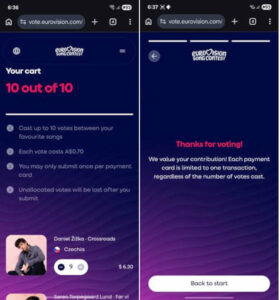
During the Second Semi Final on 14 May 2026, across the voting window period of just under 16 minutes, we put this system to the test, focusing on the reduced number of votes per viewer.
Casting The Maximum Number Of Votes
Our results were that we were able to cast a total of 90 votes during the period for the same two countries, by one person utilising one device. The only visible constraints were the requirement to use nine unique bank card numbers and nine unique email addresses.
This unique email address requirement is a new addition to the 2026 voting system.
The cards used were a mix of personal, virtual, and prepaid credit cards. The latter two options are easily accessible to anyone over the counter or online without ID, or via their online banking app. None of these were rejected during the voting process.
Whilst it is now actively encouraged to distribute votes across a number of entries, with the hosts making statements several times to that effect, this is not enforced by any of the voting frameworks.
It is widely accepted that the majority of casual viewers and voters on the night of the Contest will vote at most 10 times because that is what the show tells them is possible. These are people who mainly tune in for that one night – most likely their only touchstone with the contest for the year – and expect that their votes are the ones that can actually have an impact to determine a final result.
Yet there is a sting in the tail… 10 is the maximum number of votes per payment method.
If someone is paying attention, it is displayed in the small print on the screens outlining voting during the show.
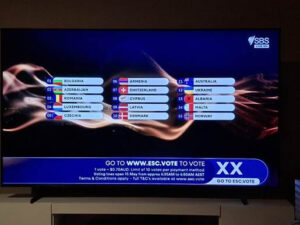
The per-payment method statement not only permits an individual with multiple credit cards to cast more than 10 votes, but also allows multiple votes across a range of devices, regardless of whether they are using phones, tablets, or a desktop computer, as stated in the official voting rules on Eurovision.com.

The Impact Of A Lower Maximum
The reduction of maximum votes from 20 down to 10 is most likely going to reduce the overall number of votes received. The general audience is being encouraged to ‘spread the love’ of their 10 votes across their favourite performers.
This makes it more likely to flatten the distribution of votes, lowering the number of votes one performer would need to reach the top ten.
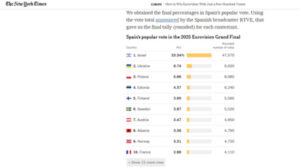
Earlier this week, the New York Times analysed voting data from 2025 supplied by the Spanish broadcaster RTVE, offering some insight into the impact. The Times claims it would have taken 482 voters to equal the 47,570 votes cast in Spain for KAN’s Yuval Raphael last year. However, that would only be the case if each of those voters used only one payment method. It would likely have taken far fewer individuals to cast multiple votes if voting had been conducted the same way as in our experiment.
The Checkered History of Eurovision Voting
The knowledge of vote manipulation is nothing new for Eurovision. We can look back at the likes of the 2013 reports from Lithuania’s 15min.lt investigation into Russia and Azerbaijan buying televotes, or the large-scale targeted advertising campaign across YouTube last year undertaken by government-funded Israeli associations encouraging maximum voting for their entry reported by the EBU’s Spotlight News team.
As rehearsals began in Vienna, the EBU issued a formal warning to KAN, stating:
“…a direct call to use the ten votes you have available on one artist or song is also not in line with our rules or the spirit of the competition. We have sent a formal warning to KAN and will continue to monitor their promotional activities closely and take action if necessary.“
Trust In The Televote
Following investigations by ourselves and others after Basel 2025, several broadcasters demanded the release of a breakdown of all televotes. These concerns contributed in some part to five national broadcasters (from Spain, the Netherlands, Iceland, Ireland and Slovenia) withdrawing from the 70th Edition of the Eurovision Song Contest.
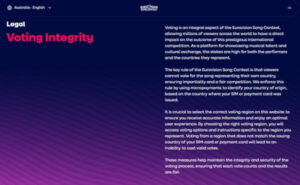
Voting at the Song Contest is promoted as ten votes per person. As noted by the EBU itself, this limit can be overcome with multiple payment methods. Those with vested interests would find it easy to obtain pre-paid cards or generate multiple one-time card numbers from their banking apps.
The success of the Eurovision Song Contest has been built on the trust and connection among the community, broadcasters, and the EBU over the course of 70 years. Questions raised over 2025’s televote have eroded that trust. Until these are answered to the satisfaction of all, the legitimacy of the Contest’s results will continue to be called into question.