
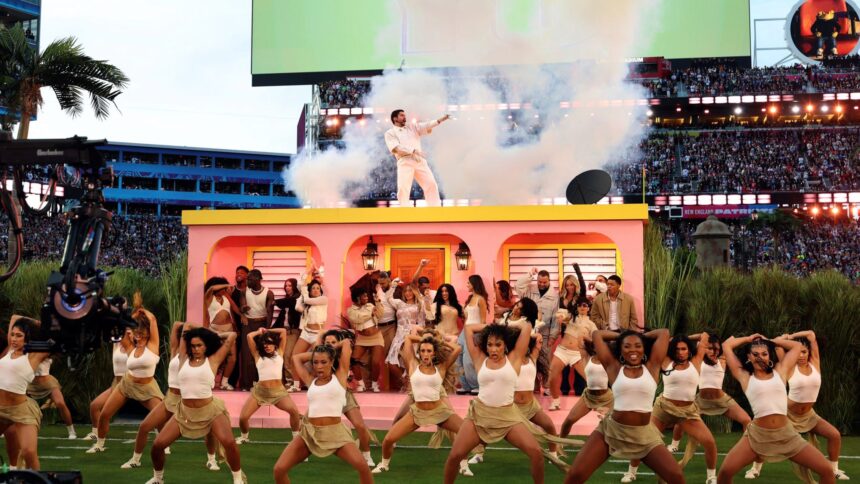
The celebratory, symbolic set design for Bad Bunny’s Super Bowl halftime show allowed the artist to “make his comments in a way that felt elegant,” according to its creative director Harriet Cuddeford.
Puerto Rican artist Bad Bunny, whose real name is Benito Antonio Martínez Ocasio, headlined the show during the 60th Super Bowl football game, which took place at Levi’s Stadium in California on 8 February 2026.
The show was a celebration of Latin American culture and was full of symbolism, fitting for the first artist to perform this event predominantly in Spanish.
To create the immersive setting through which the performance unfolded, the artist worked closely with Cuddeford and show designer Yellow Studio, which also devised the staging for the Grammy Awards last week.
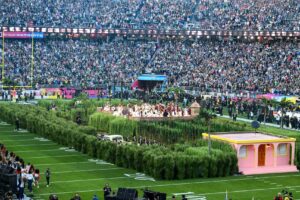
From the show’s conception, the aim was to create “something that feels cinematic, that tells a story, and that shows a journey,” Cuddeford told Dezeen. “For Benito – front and centre of everything – he said: ‘I want to represent Latino people. I want to get them to be seen and loved and shown on the biggest stage in the world’.”
At the same time, he wanted “to speak to everyone” and “celebrate the things that make life worth living: dancing, music, love, family, togetherness,” Cuddeford added.
The design team travelled to Puerto Rico – a US territory in the Caribbean – to soak up the culture and find creative inspiration before storyboarding and then producing the 15-minute show.
They transformed the football pitch into a landscape that echoes the island’s grassy fields, and incorporated several references to its architecture, infrastructure and culture.

Along a continuous “surreal journey” from one end of the football field to the other, this series of interconnected structures created vignettes for Bad Bunny – as well as special guests Lady Gaga and Ricky Martin – to perform within while also connecting to the music’s themes.
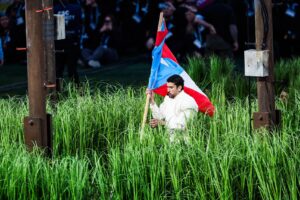
In the beginning, the camera followed the headliner along a path cut through tall grass that represented Puerto Rico’s agricultural heritage.
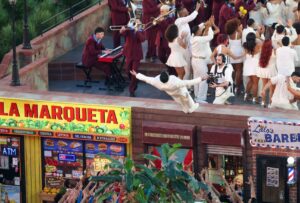
He passed vendors such as taqueros, piragüeros, and nail technicians, “paying homage to everyday people,” before arriving at La Casita – a representation of a traditional rural Puerto Rican house that previously appeared during his residency on the island last year.
“La Casita has been a huge architectural and design touch point of the whole campaign,” said Cuddeford, so they recreated the pink structure for this show, complete with a porch, louvred windows and lanterns.
Next, a real wedding ceremony and party took place on an elevated stage modelled on a plaza in Puerto Rico’s capital, San Juan.
A recreation of a Latino neighbourhood in New York City included a bodega, a barbershop and a faithful recreation of the Caribbean Social Club in Brooklyn – from which its owner, Toñita, handed Bad Bunny a shot.
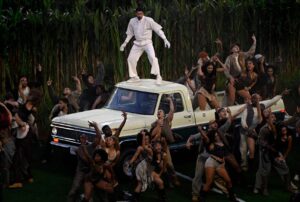
“The level of detail in those in those buildings was crazy,” Cuddeford said. “We wanted to make it as authentic as we possibly could, as we did across the whole design, making sure that everything was so culturally on point and authentic.”
More nods to Puerto Rico included a pair of white plastic chairs set against a backdrop of plantain plants, which feature on Bad Bunny’s album artwork for his sixth, Debí Tirar Más Fotos.
Also, a series of climbable power lines that intermittently sparked the island’s struggling electricity grid – a cause of ongoing political tension, which Bad Bunny addresses in his song El Apagón.
“That was a really fun design element for me,” said Cuddeford. “I wanted him to be able to climb, and do stunts and aerial work,” despite the artist being afraid of heights, she noted.
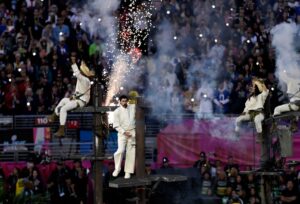
The set concluded with a parade of flags from multiple countries across the Americas, and a football introduced at the start returned inscribed with the message “Together we are America” and a huge billboard atop the stadium displayed the phrase “The only thing more powerful than hate is love”.
“The intention was to talk about things and look at things, but not be on the nose, too descriptive, or try to jam things down people’s throats,” Cuddeford said. “Let’s have joy and celebration and fun, but let’s also make his comments in a way that felt elegant, and that people could discover if they wanted to.”
Producing such an ambitious live production in the middle of a major sporting event presented several challenges from a logistics standpoint.
The stadium itself had no roof or rigging, Cuddeford explained, and the performance was also scheduled during daylight hours.
To load the staging on and off the field within the time constraints, all of the elements were constructed on “carts” that measured no larger than 24 by eight feet. These also had to weigh under 5,000 lbs, so as not to damage the playing surface underneath.
Anything over 10 feet tall (3 metres), including the power lines and palm trees, had to be hinged and unfolded once in position. “It’s really constrictive what you can do, so we had to think cleverly,” Cuddeford said.
With a capacity stretching to upwards of 80,000, Levi’s Stadium was completed in 2014 by HNTB as a home for the San Francisco 49ers NFL team, and has also played host to other sports and music events.
During this year’s Super Bowl, some blind and low-vision fans were be able to experience football more directly thanks to tactile devices that vibrate to indicate the position of the ball on the field.