
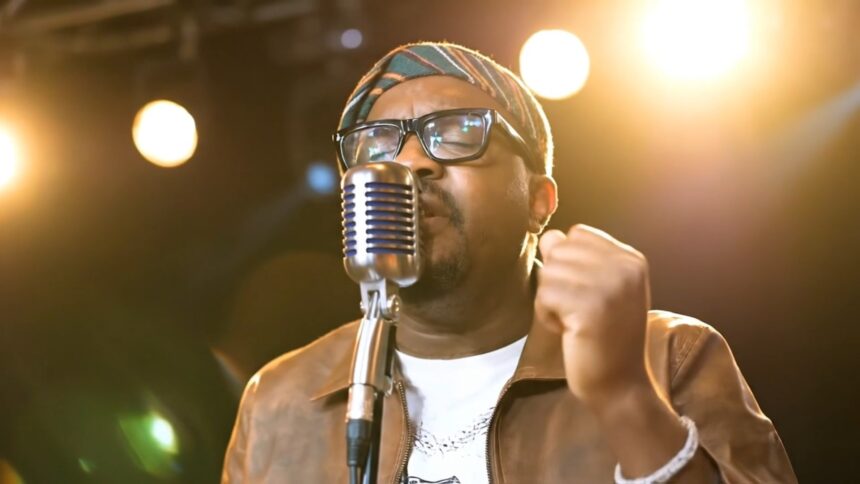
1. How did your journey into music begin, and what shaped your sound in the early years?
ANSWER: I was as a matter of fact, born into Christian music family. Both dad and mom were members of the choir in The Apostolic Church. I watched them singing in the mass choir podiums. For decades, and until I became a teenager, I listened to my dad, changing the old black plate discs, playing Jim Reeves, Don Gibson, Ray Price and the old school African music of the likes of Bola Are and co. These are the sounds that I repeatedly listened to for days and later could mime while I was growing up as a child.
2. What does Afro-Soul and Afro-Jazz mean to you personally?
ANSWER: I play African music in a western soulful way and sometimes, I could incorporate few jazz notes and improvisation into my sound. This is the only way for me to convince music adepts that two distinct sounds can be merged to form one beautiful sound, Afro-soul and/or Afro-jazz. The lyrics employed in passing messages across in this musical experiment could be any subject such as love, prayers, unity, struggles, politics and even abstract philosophy such as epistemology, metaphysics, logics etc. So, to me, the two coined genres mean unity, hope for the commonality, spirituality etc.
3. How does Yoruba culture influence your songwriting and performance style?
ANSWER: Even though, I have travelled across the globe and now permanently resides in the USA, I am a Yoruba man that grew up in Nigeria. I eat, drink and live the culture. Even though you can hear some expression of English language in my compositions, I still feel more comfortable passing some messages across to my audience in a plain Yoruba language. By the by, majority of my audience are Yoruba speakers.
4. Your music blends tradition with a global sound — how do you balance both worlds?
ANSWER: Music is just one universal language. We all know that. Hence, it is very easy for me to blend the two worlds of Yoruba sound and western style. Besides, I went through the conservatory to study western music like Jazz and classical music. This academized skill coupled with my natural ability to be able to perform the Yoruba music smoothens every endeavor.
5. What inspired your upcoming release “Agbarakọ”, and what story does it tell?
ANSWER: The term “Agbarakọ” is a Yoruba language which simply means “Not by power”. In this life, there is one energy that is superior to “power”. It is called “wisdom”. You can manifest wisdom. Majority of Nigerians believe in “prayer”. The song “Agbarako” is simply encouraging humanity to embrace wisdom instead of power. Manifestation through prayers instead of application of unneeded struggles.
6. How is Agbarakọ different from your previous works like Bẹkunji or Ajagbeegun?
ANSWER: I will say the three songs aren’t that different because they emanated from the same creativity source. And, I can still say the songs are entirely different because they are of different rhythmic structure, chords accompaniment, messages and different grooves even though they are all from one source. “Agbarako” is more soulful and focuses more on message unlike “Bekunji” and “Ajagbeegun” that are more groovier and pushes one to dance more.
7. What role does live band performance play in how you express your music?
ANSWER: Oh! You can’t compare and undermine the power of musical works that are naturally expressed to electro-computer music. Hence, I love hiring the expertise of skilled musicians to come and help me to achieve the natural sounds needed and aspired in my compositions.
8. Can you tell us about the Tribal Invaders Band and how that collaboration came together?
ANSWER: The tribal invaders band was formed by Alani Nightingale in the year 2001. Although it has gone through a lot of changes ever since then, but the band remains as effective as it can be, growing every day with new members coming in every time.
9. What emotions or message do you hope listeners take away from your music?
ANSWER: Music appeals to people in different ways. Irrespective of what I want my listeners to feel when listening to my music, the music will speak to them in different ways. Hence, I will just say, people should just take their time to bask in the aura of my music anyway or anyhow they would love to.
10. How has performing across different cities or cultures influenced your artistry?
ANSWER: Touring and globetrotting have really exposed me to different cultures, musical styles and different professionals. I have sometimes ago found myself in different rural communities where there is a high disparity in spoken language and I have sometimes been able to collaborate and perform with some of the musicians in these remote communities despite our differences.
11. What challenges have you faced staying authentic while evolving musically?
ANSWER: At my early years in music, it was finance, but now, it’s actually working with professional musicians to help me perform my music the way I really want it. I am often faced with this challenge when I unavoidably have to work with the wrong people who don’t really share my musical idea.
12. How do you see African indigenous music fitting into the global music space today?
ANSWER: It’s already happened and it is still happening. For example, who doesn’t know what Afrobeats music is today, across the world? Thanks to the likes of King Sunny Ade, Angeli Kidjo, Richard Bona, Lokua Kwanza, Fela Kuti, Papa Wemba, Yisundu and the 21st century generation of Nigerian music artistes.
13. What should fans expect from you in this new phase of your career?
ANSWER: I have a lot up my sleeves to get done globally when it comes to experimenting the chore African music with the western. Let me just say my audience should keep their fingers crossed. There’s a lot to achieve and we haven’t started yet.
14. If your music were a message to the world, what would it say right now?
ANSWER: Just make the world tenantable for every human to dwell in.
15. Where do you see Alani Nightingale in the next few years creatively and culturally?
ANSWER: The world stage, performing with world class music artistes and symphony orchestras.