

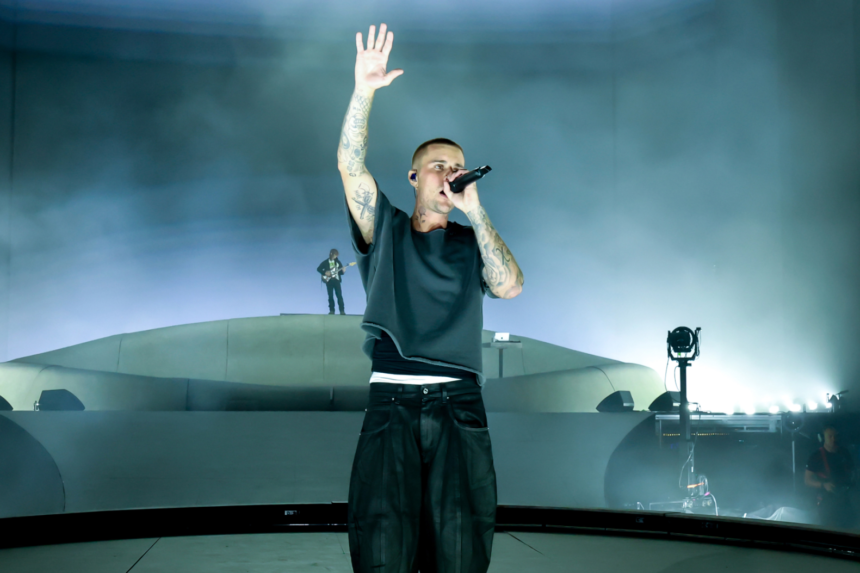
When Justin Bieber took the stage at Coachella on Saturday night, the performance quickly became the most contested headline set in recent festival history, drawing intense scrutiny that extended far beyond questions of vocals or production design and into a broader conversation about how live performance is interpreted within a media environment shaped by constant circulation, commentary and reinterpretation.
Bieber reportedly earned close to $10 million for the appearance, placing the set among the highest-paid in Coachella history, yet the creative execution leaned heavily into minimalism, with the defining segment centered on a prolonged onstage “YouTube time capsule” in which he played viral clips, early career footage and fragments of older songs from a laptop, creating a deliberately fragmented and referential structure that resembled an internet browsing session more than a conventional festival headlining arc. Coverage from outlets like Entertainment Weekly and Business Insider emphasized this structural choice as the defining characteristic of the show, while The Guardian noted the strength of his vocal delivery even within the restrained staging.
This decision became the focal point of both media analysis and celebrity reaction, with much of the discourse clustering around the meaning and intent behind the laptop segment rather than technical performance metrics, reinforcing that the central debate was rooted in interpretation rather than execution.
Celebrity Reactions Became A Second Performance
The most immediate and widely distributed interpretations of the performance came from other high-profile figures, whose responses functioned as a real-time framing mechanism that helped shape how the set was understood across social platforms.
Among the clearest expressions of artistic validation, Lizzo wrote, “I watched a popstar who grew up in front of the world fully transcend into his artistry last night,” positioning the performance within a longer narrative of evolution and creative maturity and reinforcing the idea that some of Bieber’s peers saw the set primarily through the lens of artistic development rather than spectacle alone.
Labrinth reinforced that interpretation with a more emphatic endorsement, writing, “JUSTIN… I SEE WHAT YOUR [sic] DOING AND I LOVE IT … BE TRUE! F–K WHAT ANYONE ELSE THINKS,” language that carried a stronger sense of solidarity and defiance than the earlier version suggested and placed the emphasis on authenticity, intention and creative independence.
A second layer of reactions leaned into humor and ambiguity, with Zara Larsson describing the experience as “It’s giving let’s smoke and watch YouTube,” a line that captured the pacing and tone of the performance while remaining playful, particularly when paired with her follow-up comment placing Bieber in her “dream blunt rotation,” which added an element of affection to the critique.